
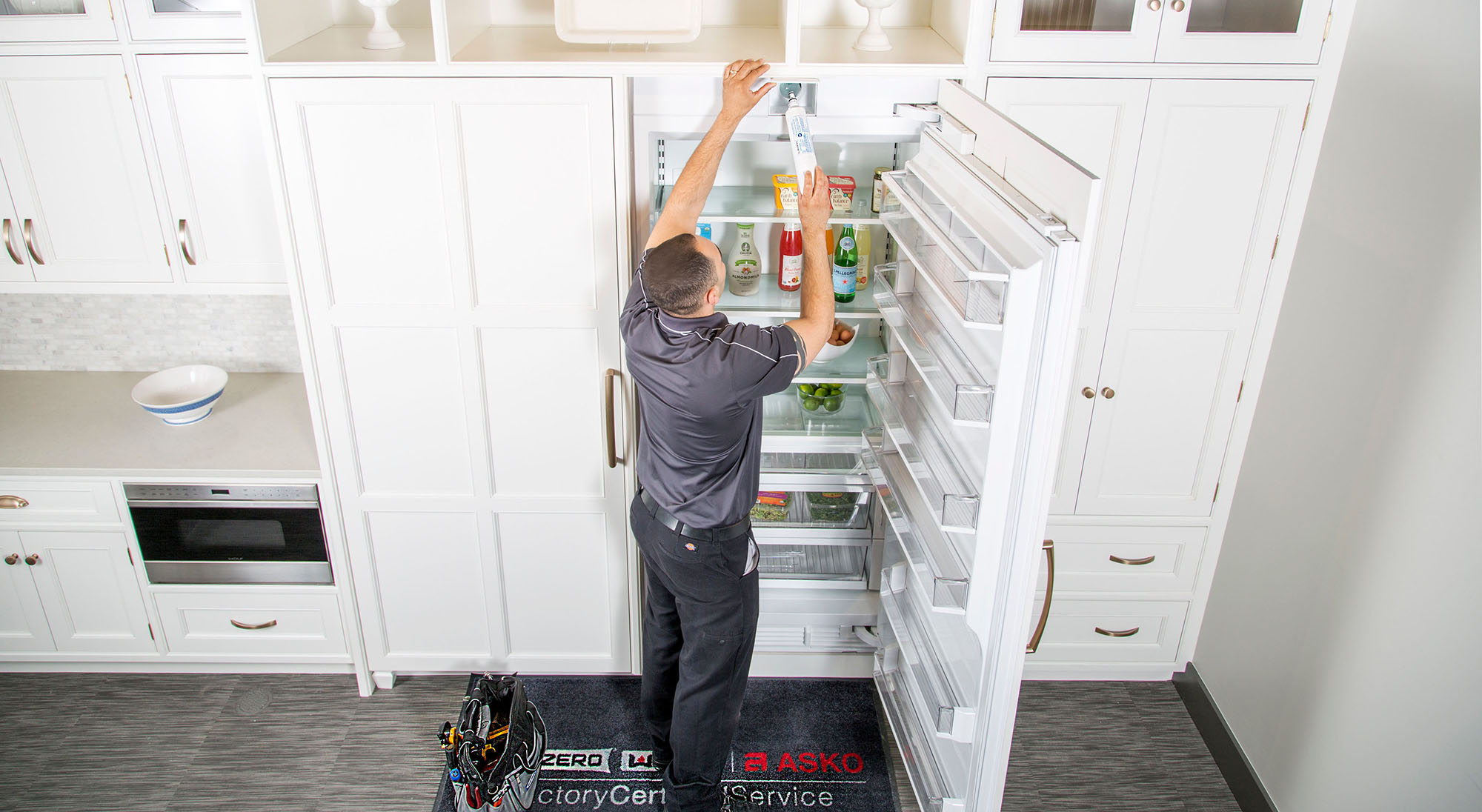
Sub-Zero Repair • Queens County
A Sub-Zero refrigerator that’s running warm rarely fails all at once. It’s usually a slow drift — a shelf that used to hold 36°F creeping up to 42°F, a freezer that takes longer to firm up ice cream, a hum that sounds just slightly different than it used to. If you’ve noticed any of this in your Queens County kitchen, you’re in the right place. Below, we’ll walk through the most common reasons a Sub-Zero stops cooling properly, what you can safely check yourself, and when it’s time to bring in a factory-certified technician.
Keeping Sub-Zero refrigeration running the way it should
Sub-Zero built its reputation on refrigeration that’s engineered to last two decades or more, with dual compressors, air purification, and precise temperature control that most refrigerators simply don’t offer. That same complexity is exactly why a cooling issue is rarely a one-size-fits-all fix — and why guessing at the problem can sometimes make it worse. Here’s what’s actually going on when your Sub-Zero starts running warm.
1. Dirty or Blocked Condenser Coils
This is, by a wide margin, the most common reason we get called out for a Sub-Zero that isn’t cooling — and it’s the one homeowners can often prevent entirely. The condenser coils release heat pulled from inside the refrigerator. When they’re coated in dust, pet hair, or kitchen grease, that heat has nowhere to go, so the compressor has to work harder and longer, and cooling performance drops.
Sub-Zero recommends vacuuming the condenser coils roughly every six months, more often in homes with pets or if the unit sits in a dusty area. On built-in models, the coils are usually accessed through a grille at the base or top of the unit; on Pro and integrated models, the location varies by series.
Signs the coils are the problem
- The refrigerator runs almost constantly, with the compressor rarely cycling off
- You feel unusually warm air venting from the base grille
- Cooling has degraded gradually over months, rather than stopping suddenly
If it’s been more than six months since the coils were cleaned, this is worth checking before anything else. It’s also one of the few Sub-Zero maintenance tasks most homeowners can handle safely themselves — we’ve put together model-specific coil cleaning walkthroughs in our Sub-Zero maintenance video library if you’d like to see the process for your specific series.
2. Worn or Damaged Door Seals
The gasket around your refrigerator or freezer door does more work than most people realize. Once it starts to crack, warp, or lose its magnetic grip, warm kitchen air seeps in continuously — and the compressor never gets a chance to catch up, no matter how hard it runs.
A simple way to check: close the door on a piece of paper or a dollar bill at several points around the perimeter. If it slides out easily, the seal in that section isn’t doing its job. You might also notice condensation forming around the door frame, or frost building up unevenly in the freezer.
Door seals are a factory part that should be replaced with genuine Sub-Zero components — aftermarket gaskets are rarely cut to the same precise tolerances the doors require, and an imperfect fit will undermine the repair almost immediately.
3. A Failing Evaporator Fan
The evaporator fan circulates cold air from the evaporator coils throughout the refrigerator and freezer compartments. When it fails, the freezer may stay reasonably cold (since it’s closer to the coils) while the refrigerator section warms noticeably — a telltale pattern that points directly at the fan rather than the compressor.
You may also hear a change in sound: a faint buzzing, clicking, or grinding noise coming from the back interior wall of the freezer, or in some cases, near silence where you’d normally hear a soft hum. A failing fan motor is a component-level repair that requires disassembly most homeowners shouldn’t attempt, both because of the labor involved and because Sub-Zero’s internal panels aren’t designed for frequent removal.
4. Thermostat and Control Board Issues
Modern Sub-Zero units rely on an electronic control board rather than a simple mechanical dial, which means temperature problems aren’t always mechanical at all. A failing sensor can report inaccurate readings to the board, causing the compressor to cycle incorrectly — running too little (and warming up) or too much (and over-freezing food in the refrigerator section).
Signs of a control issue include a display that seems to work fine but doesn’t match actual internal temperatures, error codes on the control panel, or inconsistent behavior that comes and goes. This is one area where our technicians rely on proprietary Sub-Zero diagnostic software rather than guesswork — it can often identify a faulty sensor or board issue before a technician even opens the cabinet.
5. Compressor Problems
The compressor is the heart of the refrigeration system, and while Sub-Zero compressors are built for decades of service, they aren’t immune to failure — particularly in units that are 15-20+ years old. A failing compressor often presents as a refrigerator that runs constantly and loudly but still can’t maintain temperature, or one that cycles on and off in short, rapid bursts.
This is also the point in the conversation where the repair-versus-replace question tends to come up, especially for older units. If you’re weighing that decision for your own refrigerator, we’ve written a full breakdown of when it makes sense to repair a Sub-Zero versus replace it that may help you think it through.
6. Frost Buildup and Defrost System Failures
If you’re seeing heavy frost accumulation in the freezer — beyond the normal thin layer — the automatic defrost system is likely the issue. A failed defrost heater, timer, or thermostat allows frost to accumulate on the evaporator coils, which then blocks airflow and reduces cooling efficiency throughout the entire unit, not just the freezer.
Left unaddressed, this tends to compound: less airflow means less cooling, which means the compressor runs longer, which means more strain on an already struggling system. If you notice frost building up in patterns you haven’t seen before, it’s worth having it looked at before it affects refrigerator-side temperatures as well.
Not Sure Which of These Applies to You?
Our factory-certified technicians can usually narrow down the cause before they even arrive, using Sub-Zero’s proprietary diagnostic tools. We stock genuine parts for every Sub-Zero model, which means most repairs are completed in a single visit.
Schedule Sub-Zero Repair Call (800) 853-8064Sub-Zero Refrigerator Repair Throughout Queens County
Luxury Appliance Care is the Factory Certified Sub-Zero repair partner for homeowners across Queens County, from Astoria and Long Island City to Bayside, Forest Hills, and Howard Beach. Because we work exclusively on Sub-Zero, Wolf, and Cove appliances, our technicians train more deeply on these three brands than a general appliance repair company ever could — and our trucks carry factory-certified parts for both current and older Sub-Zero models.
You can see the full list of neighborhoods we serve, along with more detail on the appliances we repair, on our Sub-Zero repair in Queens County page. And if your household also owns Wolf or Cove appliances, we service those too — our Long Island service area covers Queens, Nassau, and Suffolk Counties for all three brands.
White-glove service, on your schedule
Frequently Asked Questions
Why is my Sub-Zero refrigerator warm but the freezer is still cold?
This pattern usually points to the evaporator fan or a blocked air duct between the freezer and refrigerator compartments, rather than the compressor itself. Since the freezer sits closer to the evaporator coils, it can maintain temperature even when circulation to the refrigerator section has failed.
How often should I clean my Sub-Zero condenser coils?
Sub-Zero recommends cleaning the condenser coils about every six months for most households, and more frequently in homes with pets or in kitchens near construction dust. Neglected coils are the single most common reason we’re called out for a cooling complaint.
Can a bad door seal really cause cooling problems?
Yes. A compromised gasket allows a continuous stream of warm, humid kitchen air into the cabinet, forcing the compressor to run far more than it should. Over time this both degrades cooling performance and adds unnecessary wear to the compressor itself.
Is it normal for a Sub-Zero refrigerator to run constantly?
Some cycling is normal, especially in warm kitchens or right after the door has been open. But a compressor that never seems to shut off, paired with temperatures that still aren’t holding, usually indicates dirty coils, a refrigerant issue, or a compressor nearing failure.
How do I know if I need a repair or a full replacement?
Age, repair history, and the specific component involved all factor in. A failed door seal or dirty coils are inexpensive, quick fixes on a unit of any age. A failing compressor on a 20-plus-year-old refrigerator is a different conversation. We cover this in detail in our guide to repairing versus replacing a Sub-Zero refrigerator.
Do you use genuine Sub-Zero parts for repairs in Queens?
Always. As a factory-certified service partner, we carry manufacturer-only parts, backed by a one-year replacement warranty, and our warehouse stocks components for both current and legacy Sub-Zero models.
Ready to Get Your Sub-Zero Back to Full Temperature?
Luxury Appliance Care has served Queens, Nassau, and Suffolk homeowners with factory-certified Sub-Zero repair for years, with same-day and next-day availability and technicians who treat your home the way your appliances deserve.
Schedule Service Online Call (800) 853-8064